Procurement Plays: Handling the Squeeze Without Giving Away Margin
Procurement doesn't ambush your renewal — it runs five standard plays, and most CS teams concede to all of them. A field guide to each play and its counter, a give-get ledger that prices every concession, and a worked $280K example.
The moment procurement enters your renewal, most CS teams behave as if something has gone wrong. Nothing has gone wrong. A professional negotiator has joined a negotiation — on schedule, running a playbook their whole profession shares. The playbook works for one reason: the CSM across the table is improvising. You do not out-negotiate procurement. You out-prepare them, and you stop giving things away for free.
I spent the first half of my career treating a procurement handoff as a betrayal. The champion loved us, the QBRs were strong, the renewal was "verbal yes" — and then a calendar invite arrived from someone in sourcing I had never met, and the deal I had forecast as safe spent six weeks in a grinder and came out 12 points lighter. It took me an embarrassing number of renewals to understand what was actually happening: nothing personal, nothing about our product, nothing my champion could have prevented. Procurement's job is to extract margin from vendors, they are measured on it, and they run the same five plays on every vendor in the stack because the plays work.
Once you see the plays as standard, the fix stops being charisma and starts being preparation. This piece is the field guide I wish someone had handed me: when procurement shows up and why it is predictable, the five plays and the counter to each, and the one-page give-get ledger that is the difference between a negotiation and a slow surrender.
Procurement's arrival is predictable — so prepare before it happens
Procurement does not appear at random. Across my own book and the teams I have run, the trigger list is short: the contract crosses an ACV threshold (at most mid-market companies, somewhere around $100K, and dropping every year as cost programs spread); a new CFO or a cost-out mandate lands and every renewal above a cutoff gets sourcing review; the renewal falls near the customer's fiscal year-end, when procurement is hunting for savings to book; or a stack-consolidation review is underway and every vendor in your category is being compared on a spreadsheet you will never see.
Every one of those triggers is visible a quarter out if you are looking. Which means the correct time to prepare for procurement is T-90 — ninety days before renewal, before anyone from sourcing is in the thread — and the preparation is not a discount strategy. It is a value file: the usage receipts, the outcomes tied to numbers the business tracks, the business case your champion can forward internally without you in the room. Procurement's leverage is the absence of evidence. When the only artifact in the deal is a price, everything is a price conversation. When there is a one-page record of what the platform did this year — in the customer's own metrics — the discount conversation starts from a different floor.
The second piece of T-90 preparation is a number you set with your own leadership: the concession ceiling. Decide, before anyone asks, the maximum all-in concession this renewal can carry — I run most accounts at 8% of ACV, everything included — and price every individual give against it. Walking in with a ceiling changes your behavior more than it changes theirs. The CSM with no ceiling negotiates each request on its own merits and discovers at signature that the merits added up to 15 points. The CSM with a ceiling runs a budget.
The five plays
Five plays cover, in my experience, better than nine in ten procurement engagements. Learn to name them in the room — silently — and half their power evaporates.
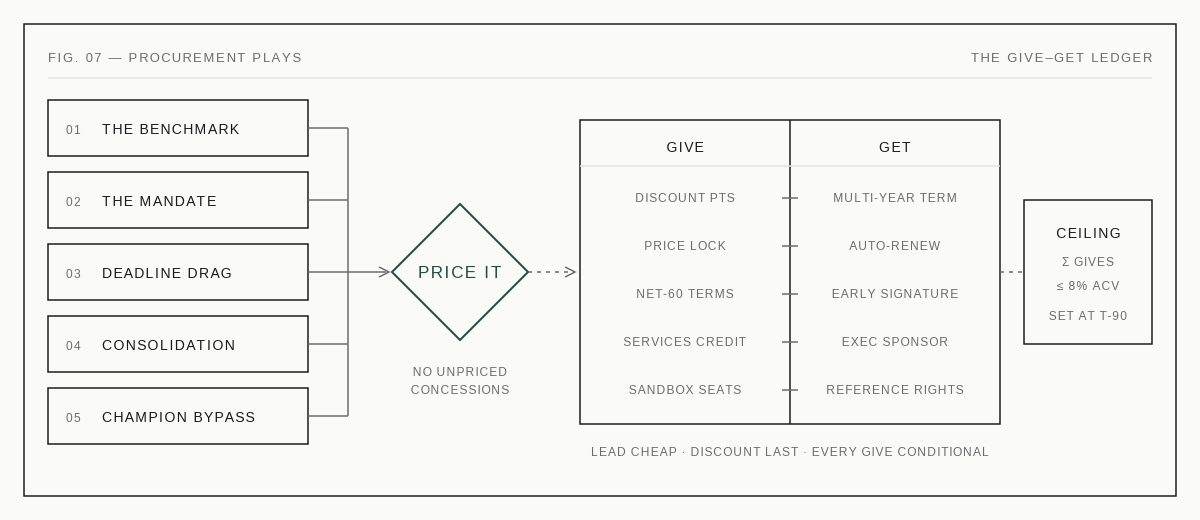
01 — The Benchmark. "We've looked at market data and you're priced well above comparable tools." The move is to make you defend your list price against an invisible dataset. The benchmark is almost never shared, because it almost never exists in the form implied — it is a category average flattened across products that do different things. The counter is not to argue the data; it is to reframe the unit. Move the conversation from price-per-seat to cost-per-outcome using the value file: what the customer paid last year, and what that bought in their numbers. Then ask, politely, to see the benchmark. You will usually never hear about it again.
02 — The Mandate. "We've been directed to take 10% out of every vendor contract this year." Sometimes true, and the play is in the word "every" — a mandate is designed to feel non-negotiable because it is impersonal. But mandates are budgets, not laws, and procurement spends them where vendors resist least. The counter is to treat the mandate as an opening position and respond with the ledger: a path to their number that is paid for — term, commitment, timing — rather than donated. Vendors who concede the 10% unpriced in week one are funding the exceptions granted to vendors who did not.
03 — The Deadline Drag. No aggressive demand, just silence. Documents take two weeks to review. Legal is "backed up." Suddenly the renewal date is eleven days out and you are being offered a choice between a steep discount and a lapsed contract your CRO will ask about. Urgency is being manufactured because urgency is priced: across my own book, the discounts signed in the final week of a term have run roughly double the ones signed thirty or more days out. The counter happens at T-90, not at the wire — an agreed paper timeline with your champion, escalation dates attached — plus the one thing CSMs forget they can use: your own calendar. A renewal that lapses hurts the customer too; the team using the product rarely wants the outage procurement is casually threatening. Make the operational cost of the drag visible to the people who feel it.
04 — The Consolidation Threat. "We're evaluating alternatives as part of a platform consolidation." Occasionally real, and the real version is visible long before procurement says it — usage decay, a sponsor gone quiet, an RFP you heard about from the field. Said for the first time inside a renewal negotiation, it is usually theater: switching costs are real, migrations are expensive, and procurement knows both. The counter is to calmly cost the alternative — migration, retraining, the outcomes at risk, in their numbers — and to never respond to the threat with a panic discount, which teaches the account that the threat is a button that dispenses money. If the threat is real, it is a save motion and a different playbook entirely; pricing is almost never why you actually lose a consolidation.
05 — The Champion Bypass. Procurement asks that all further communication run through sourcing, and your champion goes quiet. The play removes the person who knows what the product is worth from the room where its price is set. You cannot refuse the process, and trying reads as hiding something. The counter is to arm the champion instead: they can be absent from the negotiation but present in the building. The business case lives with them; renewal risk to the roadmap they care about is their internal talking point, not yours. A champion who forwards one line — "we need this renewed cleanly, the Q1 launch depends on it" — to the economic buyer does more than three weeks of your emails to sourcing. If you built the multithreading map, this is the play it exists for.
The give-get ledger
The single discipline that separates teams that survive procurement from teams that fund it: nothing leaves the table unpriced. Every concession costs you something real, so every concession is paired with a get of comparable value — and the pairing is decided before the negotiation, not invented under pressure. This is the ledger I run:
| The give | What it really costs | The get that pays for it |
|---|---|---|
| Discount points (4–6 max) | Comes straight out of NRR, compounds every year, resets the price floor forever | Multi-year term (24–36 mo) with committed value locked |
| Price lock at flat renewal | Forgoes next year's uplift (typically 5–8%) | Auto-renew clause, 60-day notice window |
| Extended payment terms (Net-60/90) | Cash timing, collections risk | Signature 30+ days before term end |
| Services or training credit | Real delivery hours, but cheaper than discount | Named executive sponsor, standing QBR seat |
| Added sandbox / admin seats | Marginal cost, high perceived value | Public reference, case study, or review rights |
Three rules make the ledger work. First, the order of gives matters: lead with the cheap-to-you, high-perceived-value rows (seats, credits, locks) and treat discount points as the last give, not the first — most CS teams run this exactly backwards. Second, every give is conditional in the same sentence it is offered: "we can do X if the agreement includes Y" — never "we can do X," followed by hoping. Third, the gets are not decoration. A 24-month term at a 5% discount is better NRR math than a 12-month term at list with a procurement fight scheduled again next year; signature 30 days early is a forecast you can actually call; reference rights are pipeline. The ledger is not about winning the negotiation. It is about making sure both columns have entries when it ends.
Sum the column as you go. When the gives hit the ceiling you set at T-90, the answer to the next ask is the ceiling, not your resolve in the moment. "We've reached what I can put into this renewal — let's talk about which of these gives matters most to you" is a sentence that ends negotiations politely. It only exists if the ceiling was set before the pressure started.
A worked example
A $280K platform renewal, mid-market logistics company, new CFO, renewal date March 31 — their fiscal year-end. Procurement entered at T-45 with the Benchmark ("comparable platforms are 20–30% below your pricing") and an opening demand of 15%, followed immediately by the Deadline Drag: two weeks of silence after every document.
The counters, in sequence. The account team had built the value file at T-90: platform usage up 22% year over year, and two outcomes in the customer's own numbers — a claims-processing cycle the operations VP had publicly credited with a 9-day reduction, and an audit the platform had carried. The benchmark reframe went back within 48 hours: cost-per-processed-claim, year over year, alongside a polite request for the comparable dataset. The dataset never appeared. The champion — bypassed per play 05 — was armed instead: a one-page business case and one internal line about the Q2 expansion her team had scoped on the platform. She sent it to the CFO's office without being asked twice.
The ledger closed it. Against the 15% demand: a 4% discount conditional on a 24-month term, plus a price lock for the second year conditional on auto-renew with a 60-day notice window, plus a services credit for the admin migration they had been deferring conditional on signature by March 10. All-in concession value: roughly 7% of ACV, inside the 8% ceiling set at T-90. Signed March 8 — 23 days before term end, with the next renewal already de-risked by the term length. Procurement booked a win for the fiscal year. The account's NRR trajectory kept its uplift path from year three. Both of those sentences are true at once, which is what a well-run procurement negotiation looks like.
Run the alternative in your head: no value file, no ceiling, no ledger. The 15% demand meets an improvising CSM at T-11, lands at 12%, one-year term, and the same fight is on next year's calendar with a lower price floor. The delta between those two outcomes — on this one account, in year one alone — is about $22K, and it compounds. That is what preparation is worth, per account, per year.
What this changes on Monday
Pull your renewals due in the next two quarters and flag every account that matches a trigger: ACV above $100K, new CFO or active cost program, fiscal year-end renewal date, or consolidation noise anywhere in the stack. Those are your procurement renewals — whether or not procurement has shown up yet.
For each one: build the value file now, not at T-30; set the concession ceiling with your leadership in writing; draft the give-get ledger with the rows you can actually offer; and confirm the paper timeline with your champion while they are still in the thread. One working session per account, and the next time a sourcing invite lands in your calendar, it is not an ambush. It is a meeting you have already prepared for, with a professional across the table who is about to discover that this particular vendor prices its concessions.
This piece joins the Renewal Engine pillar alongside the forecast and multithreading frameworks. The give-get ledger follows the same rule as every rubric on this site: decided in advance, defended line by line. A one-page ledger template is in the tools library, and The NRR Playbook sends one tactical idea like this every week.