The Capacity Math: How Many Accounts a CSM Can Actually Carry
Account counts lie, and ARR-per-CSM lies differently. A weighted load model that scores a book in fifteen minutes, the capacity line it implies, and the rebalance trigger that catches an overloaded CSM before the misses reach the forecast.
Ask a CS leader how loaded their team is and you will get one of two numbers: accounts per CSM or ARR per CSM. Both are easy to pull, both show up in board decks, and both are wrong in ways that cost you renewals. The fix is a third number — weighted load — that takes about fifteen minutes per book to compute and tells you, before the quarter starts, which CSM is about to start missing.
I have run the same conversation in three different orgs. A CSM with twenty-six accounts asks for relief, and the leadership answer is that a colleague is carrying twenty-nine, so twenty-six must be fine. Six weeks later the colleague with twenty-nine misses two renewals the dashboard called safe, and the post-mortem discovers what the account count was hiding: five accounts in onboarding, four renewals landing in the same window, three in escalation. The twenty-six-account book was a rotation of quiet check-ins. The twenty-nine-account book was a quarter of simultaneous fires. Same team, same "load," completely different jobs.
Account count treats every logo as identical work. ARR per CSM is worse in a subtler way: it implies that a $400K account is eight times the work of a $50K one, when the $50K account mid-escalation with a procurement-heavy renewal is routinely more consuming than the $400K account on a multi-year ride with a healthy champion. Revenue measures what an account is worth to you. It says almost nothing about what the account demands from you this quarter. Staffing to either number is why capacity conversations in CS orgs are fought with anecdotes — the only people who know where the real load sits are the CSMs, and the dashboard keeps contradicting them.
The load unit
The model that replaces both numbers is deliberately simple: every account gets a base weight of one load unit, and a short list of conditions — each observable in your CRM, none a matter of opinion — adds or subtracts weight. The sum across a book is the CSM's load. The scale is arbitrary until you anchor it in hours, which we will do below; what matters first is that the weights move for the things that actually consume a CSM's week.
One load unit is the steady state: a healthy account on a normal cadence — the recurring call, the prep, the notes, the internal reporting, the routine asks. Everything above that is a condition with a start and an end date, which is exactly why account counts mislead: load is not a property of the logo, it is a property of what the logo is going through right now.
| FACTOR | LOAD | THE TEST |
|---|---|---|
| Base — every account | 1.0 | It is in your name in the CRM |
| Onboarding | +1.0 | Inside 90 days of signature, or go-live not yet declared |
| Renewal window | +0.5 | Renewal date inside the next 120 days |
| At-risk / escalation | +1.0 | Red health, or a named executive escalation open |
| Active expansion | +0.5 | A qualified expansion opportunity you are working, stage two or later |
| Structural complexity | +0.5 | Two or more business units, three or more integrations, or six or more tracked stakeholders |
| Digital steady state | −0.5 | Healthy, pooled or tech-touch cadence, no live motion (floor of 0.5) |
Two design choices are doing the work here. The weights are additive, not multiplied, because additive scores can be audited line by line — anyone can look at an account scored 3.0 and see the base, the onboarding, and the renewal window that got it there. And every test is a fact, not a feeling: a contract date, a health status, an opportunity stage, an onboarding flag. Five of the six conditions can be computed straight from CRM fields, which means the score refreshes itself. Only structural complexity requires judgment, and that one gets scored once a quarter by your ops lead or a peer manager — not by the CSM whose relief case it supports.
The specific weights are a starting point, not scripture. If your onboarding motion is CSM-led implementation rather than handoff-to-services, onboarding is a +2.0 in your org, not a +1.0. The way to find out is the same discipline as any baseline: have two CSMs time a representative fortnight against their books, and set the weights so the model reproduces where their hours actually went. An afternoon of calibration once — then the model runs on fields you already maintain.
The capacity line
A load score without a ceiling is trivia. The ceiling comes from hours.
Anchor the unit first: one load unit is roughly three hours of real attention per month — calls, prep, follow-up, internal advocacy on the account's behalf. Then count the hours a CSM actually has. A forty-hour week is about 170 hours a month, and before a single customer sees any of it, internal load takes its cut: forecast calls, team meetings, enablement, CRM hygiene, the deck someone needs by Thursday. In every org where I have measured it, that cut lands between 30 and 35 percent, which leaves roughly 110 customer-facing hours in a normal month.
One hundred ten hours at three hours per unit puts the sustainable ceiling at about 36 load units. Above that, the CSM is not failing — the math is. The portfolio demands more hours than the month contains, and the gap gets paid from whichever account complains least, which is usually the healthy one quietly deciding not to expand.
Both anchors — three hours per unit, 110 available hours — should be re-derived from your own timing data, not taken from this page. What should survive contact with your org unchanged is the structure: a ceiling in units, derived from hours, written down before anyone argues about a specific book. Once the line exists, three thresholds matter:
Under 30 units, the book has slack, and slack is where expansion plays and multithreading work actually happen — it is capacity you are investing, not waste. Between 30 and 36, the book is full: sustainable, but every new assignment displaces something. Above 36, the book is overdrawn, and you should assume the forecast for that book is optimistic, because the first casualty of an overdrawn book is the proactive work that keeps surprises out of renewals.
Two books, one team
Here is the pair that sold the model internally the last time I rolled it out. Same team, same segment mix on paper.
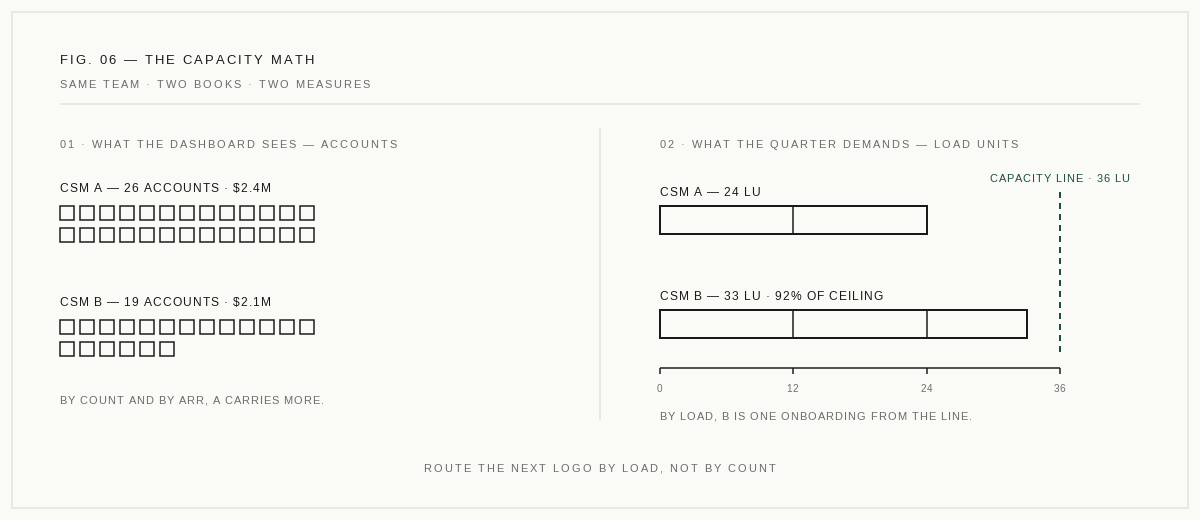
CSM A: twenty-six accounts, $2.4M under management. Eight of them are digital-tier — healthy, pooled cadence, no live motion — which subtracts four units. Two renewals inside the window, one account at risk. Load: 26 base, minus 4.0 digital, plus 1.0 renewals, plus 1.0 at-risk — 24 units. A busy, healthy book with room for exactly the kind of proactive motion the expansion plan assumes.
CSM B: nineteen accounts, $2.1M. Smaller book, less ARR — by both dashboard numbers, the lighter job. Except five accounts are in onboarding (+5.0), four renewals land inside the same 120-day window (+2.0), three accounts are red and two of those have open executive escalations (+3.0), two expansion opportunities are in flight (+1.0), and six accounts clear the complexity test (+3.0). Load: 33 units. That is 92 percent of the ceiling, one onboarding assignment away from the line — and when the next new logo in that segment closes, the routing rule based on account count will hand it to B, because nineteen is less than twenty-six.
That last sentence is the entire argument. Every capacity decision in that org — assignment, relief, hiring — was keyed to the one number that pointed the wrong way. Load scoring did not just explain why B felt buried; it predicted which renewals would wobble a quarter before they did, because the at-risk flags and the renewal stack were already in the score while the ARR dashboard was still green.
Running it monthly
The model earns its keep as a standing rhythm, not a one-time audit. Three rules keep it honest.
Re-score on the first of the month, from fields. Since five of six conditions compute from the CRM, the monthly re-score is a fifteen-minute review of exceptions, not a data entry exercise. What you are watching is movement: a book that jumped four units did not get busier gradually — something specific happened, and the delta names it.
Rebalance on pattern, not on pain. The trigger I use: any book above the ceiling once, or above 90 percent of it for two consecutive months, gets accounts moved — before the CSM asks, and before anything misses. Rebalancing after the miss costs you twice: the renewal, and the lesson every CSM learns about what it actually takes to get relief.
Let the team's total drive hiring. Sum the load across the team and divide by the ceiling: that is the headcount the current book actually requires, independent of anyone's opinion about who is busy. When the team runs above 90 percent of aggregate capacity for a full quarter, the next miss is already scheduled — the req should be open before it lands. This is also the version of the capacity conversation a CFO will engage with: not "the team feels stretched," but "we are carrying 197 units against 180 of sustainable capacity, here is the model, here is what each unit costs in hours." Load math converts a morale complaint into a staffing calculation, and staffing calculations get funded.
There is one more use that surfaces on its own. New-logo routing keyed to load instead of count ends the quiet unfairness every CSM already knows about, where the reward for running a clean book is more accounts. When assignment goes to the lowest-loaded book, the incentive finally points at the behavior you want: resolve the escalation, land the onboarding, and your score drops — visibly, in a number everyone can read.
What this changes on Monday
Score one book — your most loaded CSM's, by their own account rather than the dashboard's. Fifteen minutes with the table above and the CRM open. If the score lands somewhere the account count would never have predicted, you have just found out which of your capacity decisions are being made on the wrong number — and you can be the one holding the model before the next routing decision, relief request, or headcount ask turns into a fight about feelings.
This piece is the second in the CS Operations pillar, alongside the health score design framework — and the same rule applies to both: scores anchored to facts a stranger could verify, thresholds committed before the argument starts. The scoring sheet is in the tools library, and The NRR Playbook sends one tactical idea like this every week.